
Tag: Books

  • doodled: NY Times’ Spotlight on Gabo’s Digital Archive

    doodled: NY Times’ Spotlight on Gabo’s Digital Archive

    A version of this article by  appears in print on , on Page C3 of the New York edition [of the New York Times]

    doodled: NY Times’ Spotlight on Gabo’s Digital Archive
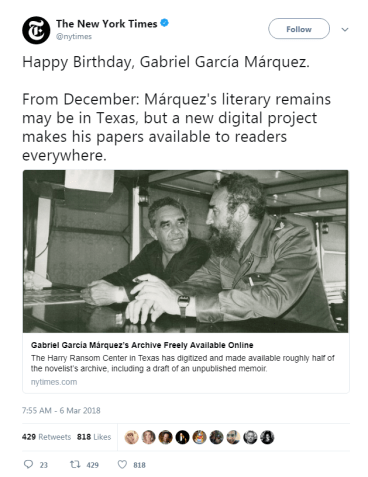
    @nyTimes_8AM_3-6-18

    When Gabriel García Márquez’s archive was sold to the University of Texas two years ago, some decried the fact that the literary remains of Latin America’s foremost novelist — and a fierce critic of American imperialism — had come to rest in the United States.

    But now, the university’s Harry Ransom Center has digitized and made freely available about half of the collection, making some 27,000 page scans and other images visible to anyone in the world with an internet connection.

    The online archive, which is cataloged both in English and in Spanish, includes drafts and other material relating to all of García Márquez’s major books, including “One Hundred Years of Solitude,” which turned the Colombia-born writer into a global figure. There are also previously unseen photographs, notebooks, scrapbooks, screenplays and personal ephemera, like a collection of his passports.

    Many archives are digitizing their holdings. But to make so much material from a writer whose work is still under copyright freely available online is unusual.

    “Often estates take a restrictive view of their intellectual property, believing scholarly use threatens or diminishes commercial interests,” Steve Enniss, the director of the Ransom Center, said. “We are grateful to Gabo’s family for unlocking his archive and recognizing this work as another form of service to his readers everywhere.”

    Seeing some items in the archive, which the Ransom Center bought for $2.2 million, will still require a trip to Texas. The digital collection does not include any of the 10 drafts of García Márquez’s final, unfinished novel,“We’ll See Each Other in August.” (One chapter of the novel was published in the Spanish newspaper La Vanguardia in 2014, shortly after García Márquez’s death at age 87; the estate said via email that it has no further plans for publication.)

    [A draft page from Chronicle of a Death Foretold showing highlights and revisions. Credit: Harry Ransom Center]

    But online readers can access a 32-page draft section of the projected second volume of García Márquez’s memoirs, which would have covered the years after he moved to Europe and then Mexico City, where he wrote “One Hundred Years of Solitude” and lived until his death. They can also use a special viewer to make side-by-side comparisons of different drafts of various works as they evolved.

    Alvaro Santana-Acuña, a sociologist at Whitman College who is working on a book about the history of “One Hundred Years of Solitude,” said the archive was already helping to explode some of the legends surrounding the novel, many of which were carefully crafted by García Márquez himself.

    The novelist, who won the Nobel Prize in 1982, had often spoken of the book as pouring out in a kind of magical trance. “I did not get up for 18 months,” he later said.

    But in fact, Mr. Santana-Acuña said, correspondence in the archive shows that he regularly sent out sections for reactions from friends and literary critics. He also published about a third of the chapters in newspapers around the world before the book’s publication, and sometimes made adjustments according to audience reaction, much as 19th-century writers like Charles Dickens would.

    “He published the most important chapters, to make sure he knew what different audiences — ordinary readers, literary critics, the intelligentsia — thought,” Mr. Santana-Acuña said.

    García Márquez, like many writers, claimed not to bother much with reviews, especially negative ones. But the archive includes a number of scrapbooks which carefully compile — and sometimes privately respond to — reviews of his work in many different languages.

    googleDoodle

    [Today’s Google Doodle for March 6, 2018 celebrates Gabo’s 91st birthday / Credit: Google.com]

    Mr. Santana-Acuña said he was particularly amused by a notation on a second review of “One Hundred Years of Solitude” that appeared in the conservative Colombia newspaper El Tiempo, which had initially dismissed the novel as badly written left-wing propaganda.

    “Al menos por larga y entusiasta!” García Márquez (who in the 1950s had written for a rival Colombian newspaper) wrote of the second effort — “At least it’s long and enthusiastic!”


     

    Follow New York Times on Twitter: @nyTimes & culture reporter, Jennifer Schuessler on Twitter: @jennyschuessler.


  • Day 4. Ujamaa, #CELEBRATE, Ch. 3

    Day 4. Ujamaa, #CELEBRATE, Ch. 3

    E90C4654-B9B1-40FE-BE4D-05D316A42F93

    / We don’t borrow
    from Africa,
    we utilize
    that which was ours
    2 start with.
    The culture
    provides a basis
    4 revolution
    + recovery. / -Maulana Karenga

    (7 Days of Kwanzaa. 7 Excerpts from Chapter 3 of a forthcoming essay series, #CELEBRATE: Meditations on a Black Festive Culture)

    Chapter 3. Reincarnation: “KWANZAA”

    Day 4.  Ujamaa

    This is an investigation of the black nostalgia. Within Kwnazaa is the re-imagining and performing of Africa, but not as an appropriation but as a way to overcome African-American’s tangled and confusing ethnic origins.

    Let’s take it back. At the time of Emancipation Celebrations, Africa was respected as an ancient glory but also devalued through the colonial lens transposed upon them. Civilizationism pervaded black discourses, advocating for Christianizing and Westernizing of Mother Africa. There were hints of a Pan-Africanist light within the Negritude movement. The resulting increase in scholarship of black historians and black experience abroad began to shift this consciousness. Slowly African-Americans lifted the veiled so they could see the value of African contributions, but elitism and Communist fears of the early twentieth century covered their eyes again. These small murmurings of a pan-African glory were squashed until the grand independence movements of the 1950s and 1960s. This time, Africa re-emerged as a source of cultural knowledge for good.

    Inspired by the African revolution and independence movements, Black Power advocates followed the lead of Malcolm X. They truly began to imagine a collective African diaspora that could inform and empower their own liberation from white American oppression. Africa was rising, which validated a black cultural liberation and gave them permission to connect to the Continent as their roots. A primary goal of the Black Power movement became reimagining blackness through the performance of “Africa.” Author Robert Mayes gives a useful insight, observing “that to think, act, talk, look and be black would mean to perform it, to display it, to visualize it, to manifest and actualize ‘blackness’ and ‘African-ness’ in some capacity.”

    For Black Nationalists, Ahmed Sékou Touré’s 1959 work, Toward Full Re-Africanization became the blueprint for a process of Africanization. This process included Africanizing one’s speech with slang and African language terms, primarily Swahili as well as some hand gestures. Specifically, the US Organization employed Kiswahili terms to represent the organizations different components.
    The paramilitary wing was called “Simba.” The School of Afro-American Culture was called “Mwalimu” and so on.
    Taking on Swahili names was a way to identify your past experiences with the continent. “Kwanzaa” means “first fruits” of the harvest in Swahili.

    There were also behavioral stipulations for Africanizing weddings, naming ceremonies and funerals. Members were required to wear Afros and African attire.
    Within its strict doctrine, attempt to “re-Africanize” social relations based on “tradition and reason.” The organization drew in many young previous gang members who were politicized after the Watts riots, adding a level of violent rhetoric to the organization’s culture.
    Further Some of the rules and adopted behaviors perpetuated chauvinist ideals and caused internal struggle. Beyond legal and external issues with polygamy, Kerenga’s exhaustive philosophy and his cult of personality became the source of repeated disagreements over the authenticity of African representation within the US Organization.
    The same question plagues the holiday until today, some 50 years later.

    (4/7)

    All wax prints from post titles and Instagram are available for order from @HouseOfMamiWata African fabrics shop in Houston, TX.

    Many blessings, fam &

    Habari Gani until tomorrow,

    C.

  • picking ourselves back up

    picking ourselves back up

    tumblr_o18iwf35yG1qlu3jho1_500.jpg.png

    My former Instagram page (@ana.yanae) had been a serious source of motivation for me when I was running it from 2014 to 2015, but I’ve since archived it. (See parts of it here: anayane.tumblr.com)

    Now, two years later, I am beginning my Instagram page (@Crishuana_) again to promote share what I’ve learned about connecting with God, cultivating mindfulness for folks of african-decent and the many (many, many) applications of yoga practice, so I started looking back at what I’d posted before. It wasn’t long before I started doubting whether or not I could even produce again. But, coming across this “Sunday #affirmation” post, I was immediately re-inspired. So, that where my message for today begins: we can and should be our own inspiration.

    The Buddha instructs us to be lamps unto ourselves. He says, “Rely on yourselves, and do not rely on external help. Hold fast to the truth as a lamp. Seek salvation alone in the truth. Look not for assistance to any one besides yourselves.” (The Buddha’s Farewell)

    How many of us have kept a journal or actively make a practice of keeping notes to ourselves? In my own experience, I have been journaling regularly since 2014. It had been a practice that saved me out of the depression and loneliness that came with moving to a new city and having my former partner start medical school. Writing and encouraging myself gave me strength and confidence to change my thinking and then my circumstances.

    Now, when I look at my journals from three years ago, I see the triumphs that I’ve overcome and recognize the patterns I have. Looking back reminds me that I have made it! And, with a little hard work, I will make it again. Each of us can think about the times in our life that by the grace of God, we made it over the mountains and obstacles in our lives. When we remember the blessings we’ve been to others and the great mindsets we’ve cultivated in ourselves, we can be encouraged to continue that way. Have pride in yourself and your journey! You are a triumph! Everyday you are doing your best and winning, big or small!

    Finally, if this week or this year, you were looking for some inspiration to start journaling or to pick up the healthy habit again, I am here to offer one suggestion. Take a page from chapter four Oprah’s What I Know For Sure: and keep a Daily Gratitude list. It’s easy to note the top 5 things you are grateful for every day.

    Skeptical? Let me show you how easy it can be.
    Here are mine for today: Wednesday 7/19 at 18:19-

    1. An invite to interview for a new position helping my community
    2. A running car with gas and updated insurance
    3. An encouraging call from a good spiritual friend
    4. Sunshine during the rain storm
    5. Cold water in my Thermos to keep me cool…

    May we each keep seeking God’s manifestation in ourselves such that we can be renewed without reliance on any temporary and external support. “Be transformed by the renewing of your mind. Then you will be able to test and approve what God’s will is—his good, pleasing and perfect will.” (Book of Romans 12:2, NIV) Peace to you on your journey!

    Namaste & Blessings Fam,

    -S.