Tag: Histories

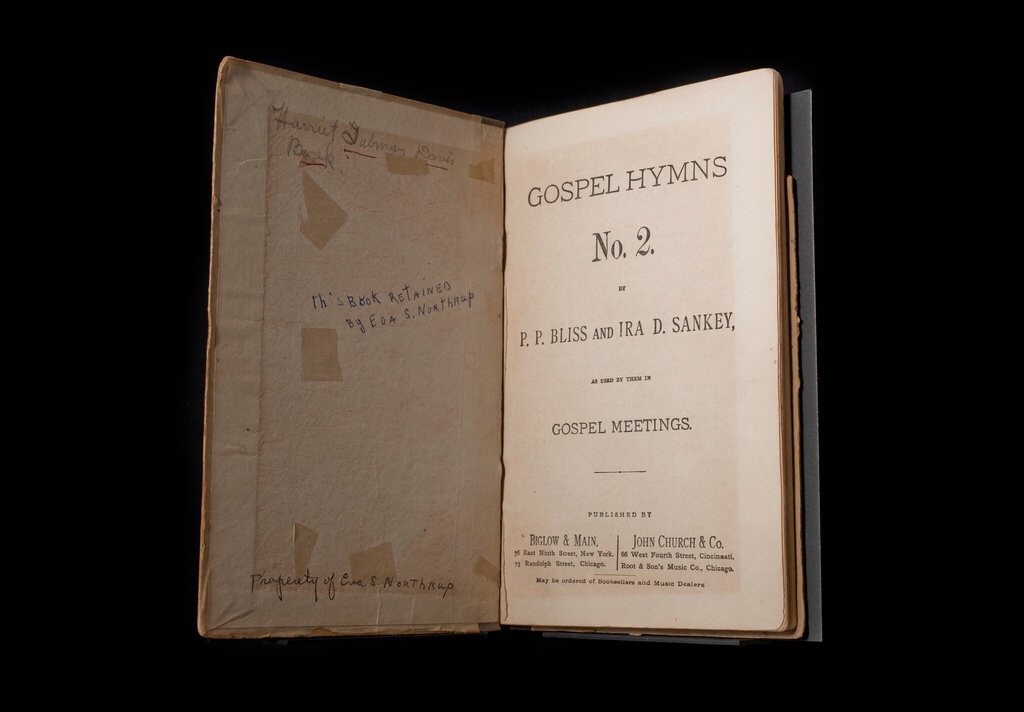
  • illiterate: the story of Harriet Tubman’s hymnal

    illiterate: the story of Harriet Tubman’s hymnal

    A version of this article by Lauren Christensen appears in print on December 24, 2017, on Page 23 of the [New York Times] Sunday Book Review

    illiterate: the story of Harriet Tubman’s hymnal

    [Photo Credit: Michael R Barnes/Smithsonian National Museum of African American History and Culture]

    In 2010, a church hymnal that once belonged to Harriet Tubman — the American abolitionist hero who, after escaping slavery in 1849, devoted her new freedom to leading hundreds more of her fellow enslaved out of captivity, first as a conductor on the underground railroad and then later as a Union spy — was donated to the National Museum of African American History and Culture by the collector and historian Charles L. Blockson.

    (more…)

  • Day 6. Kumbaa, #CELEBRATE, Ch. 3

    Day 6. Kumbaa, #CELEBRATE, Ch. 3

    25E6BA07-A474-45B0-A912-41807BED7602

    We don’t borrow
    from Africa,
    we utilize
    that which was ours
    2 start with.
    The culture
    provides a basis
    4 revolution
    + recovery. / -Maulana Karenga

    (7 Days of Kwanzaa. 7 Excerpts from Chapter 3 of a forthcoming essay series, #CELEBRATE: Meditations on a Black Festive Culture)


    Kwanzaa has a second giant to face: in the late 1970s period, the holidays had to resist against the increasing capitalism of America’s cultural institutions (i.e. museums, media, etc.). Specifically Kwanzaa had to take heed to the mainstreaming of multiculturalism. Still, we have to understand that Kwanzaa’s commercialization was complicated. Differing views on promotion and profit, exploitation and appropriation, and markets and multiculturalism caused much debate amongst Black Nationalists adopters as is true today.

    Some saw Kwanzaa as a vehicle for black participation in mainstream economic markets. They felt this was further continuation of the black cultural revolution. Others opinions wanted to invite white corporations to take part in the promotional campaigns for Kwanzaa. And then the most separatist opinions argued for a Kwanzaa was and should always be anti-commercialization. They argued that any type of commodification undermined the holiday’s reverence and sanctity.

    By the late twentieth century, the high visibility was almost entirely due to the appropriation of corporate, cultural and media institutions to gain black market share. But, in turn, the commercialization served to legitimize Kwanzaa in American public culture. Though the drive for the continued observance of Kwanzaa was shaped by Afrocentric perspectives in the 80s and the revival of Black Power styles in 90s, the political vocabulary from the 60s and 70s had became diluted into the cultural philosophy of multiculturalism.

    See, in the 1980s and 1990s, the importance of ethnicity and diversity provided previously unrealized access for people of color in a way that made them more politically, culturally and economically viable. But, it also made ethnicity a hot commodity for white owned corporations. While it’s true that entrepreneurs of color had more opportunity in this period, large white retailers primarily dominated the market for Kwanzaa promotion and black holiday observance.

    So what is Kwanzaa’s fate today? Basically, racial holiday markets provide companies a chance to increase profits while engaging in the peddling of diversity, inclusion and recognition. Black History Month has held this promise for some years now. But, museums and other cultural institutions aren’t exempt. Public discourse has folded Kwanzaa a standard part of an American year-end holiday trio. This does little more that present Kwanzaa as a token nod to diversity. And the celebration is often acknowledged simply out of goodwill or lip service for predominantly white serving institutions. Kwanzaa’s celebration in the public sphere was inherently tied to the marketplace and not a broadening of the American cultural landscape such as St. Patrick’s Day.
    Keith Mayes summarizes, “with the death of Jim Crow, Black political liberation opened up American society. Freedom, however, is a two-way street. If African-Americans gained access without, that means the dominant society also obtained liberty to move in.”

    Much like black lives, Black cultural celebrations only matter when they make American dollars.
    But, we know better.
    So we celebrate. 🎉

    keep celebrating. Ashé.
    (6/7)

    Read more on Kwanzaa’s 50th anniversary from its founder, Prof. Karenga here: http://www.ebony.com/wellness-empowerment/kwanzaa-50th-anniversary-karenga#axzz52vDztAJl

    thank you for going on this journey with me. Much gratitude to @HouseOfMamiWata in Houston, TX.
    Works cited to follow.

    Look out for the full mediation – #CELEBRATE: Meditations on a Black Festive Culture.

    As always,
    peace & blessings
    to you,
    family.

    Keep celebrating,
    -S.

  • Day 3. Ujima, #CELEBRATE, Ch. 3

    Day 3. Ujima, #CELEBRATE, Ch. 3

    / We don’t borrow
    from Africa,
    we utilize
    that which was ours
    2 start with.
    The culture
    provides a basis
    4 revolution
    + recovery. / -Maulana Karenga

    (7 Days of Kwanzaa. 7 Excerpts from Chapter 3 of a forthcoming essay series, #CELEBRATE: Meditations on a Black Festive Culture)

    Chapter 3. Reincarnation: “KWANZAA”
    Day 3: Ujima

    Maulana Karenga declined to join the NAACP, CORE and the Nation of Islam despite a personal invitation from Malcolm X himself. Instead he decided to join the nationalist-oriented, Afro-American Association. Here he developed and shaped his ideologies. He began learning under African liberation leaders, who based their beliefs on the premise that blacks needed to have the power to define themselves. For Kerenga, this concept finally moved beyond the scope of the Civil Rights protest strategies. Three years later, in the fall of 1965, a study group in a meeting in a Los Angeles bookstore called the Circle of Seven developed into the US organization. The name was proposed as a dual reference to the United States and to, “serve us Blacks as opposed to them Whites.”

    The members, Karenga, his wife and five others were close followers of Malcolm X, rallying around a strong belief that his death deserved to be memorialized in a national celebration. In fact, this is the first sprouting of what would become the group’s holidaymaking tradition. The US Organization got into formation under the leadership of a Malcolm X associate, by the name of Hakim Jamal, who later left the organization and went on to found the Malcolm X Foundation. Shifting into a new leadership of Maulana Karenga, the group’s emphasis on creating a cultural tradition blossomed. Kwanzaa allowed the Black Nationalists to exercise ritual, fusing the lived and imagined disapproval experience together as one.

    Historian Scot Brown in his 2003 work, Fighting for US: Maulana Karenga, the US organization, and Black Cultural Nationalism, explains that Karenga’s Seven Year Calendar “followed a pattern of long-range social and economic planning schemes, popularized by Third World nationalists and socialists during the late 1950s and 1960s.” With Kuzaliwa on May 19th, Malcolm X’s birthday and Dhabihu in February to represent Malcolm X’s martyrdom, the revolutionary alternatives inspired an entirely new calendar with a system of holidays and rituals for members and ultimately all Blacks.

    Karenga understood that cultural revolutions preceded physical revolutions and were, therefore, crucial stages of the revolution because they created the necessary foundation of identity, purpose and direction. Then, after an existential crisis with Christmas and the over-commercialization of a white Jesus, Karenga challenged the motives of Black Christianity, in an address to Valley College in 1968. He commented, “Black people can’t be Christians because if we are going to be Christians then we must be Jesus-like and Jesus was a whitey. We are going to have to defend ourselves because we are not going to get defense from heaven.”

    Kwanzaa was created to resist against white holiday representation. Plain and simple. In an article in 1977, Karenga clarified, “I created Kwanzaa in 1966 with US organization: a social change group of Blacks dedicated to the creation, re-creation, and circulation of Black culture. Kwanzaa is not a Black Christmas and not a time for expensive gift giving. It is an effort to escape this entrapment.” The agitation against Christmas is important for many Black Nationalists who often understand the religious holiday as “the handmaiden of a pathological Negro identity.” As a result, in its earlier forms and to outside observers, white and black alike, Kwanzaa as a ritual tradition appeared cultish and inauthentic.

    But, for the members it was a cultural revolution.

    (3/7)

    All wax prints from post titles and Instagram are available for order from @HouseOfMamiWata African fabrics shop in Houston, TX.


    Many blessings, fam &

    Habari Gani until tomorrow,

    C.