“I Have a Dream” is perhaps the most famous speech delivered by Martin Luther King, Jr. Like many of King’s speeches and sermons, it contains all numerous references to Bible passages.
Tag: Information
-
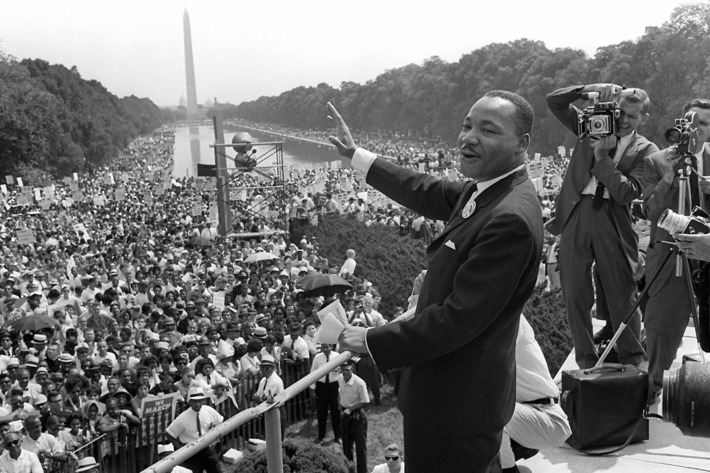
4 Scriptures / “I Have A Dream” Dr. King Wanted You to Catch
-
Day 6. Kumbaa, #CELEBRATE, Ch. 3
We don’t borrow
from Africa,
we utilize
that which was ours
2 start with.
The culture
provides a basis
4 revolution
+ recovery. / -Maulana Karenga(7 Days of Kwanzaa. 7 Excerpts from Chapter 3 of a forthcoming essay series, #CELEBRATE: Meditations on a Black Festive Culture)
Kwanzaa has a second giant to face: in the late 1970s period, the holidays had to resist against the increasing capitalism of America’s cultural institutions (i.e. museums, media, etc.). Specifically Kwanzaa had to take heed to the mainstreaming of multiculturalism. Still, we have to understand that Kwanzaa’s commercialization was complicated. Differing views on promotion and profit, exploitation and appropriation, and markets and multiculturalism caused much debate amongst Black Nationalists adopters as is true today.
Some saw Kwanzaa as a vehicle for black participation in mainstream economic markets. They felt this was further continuation of the black cultural revolution. Others opinions wanted to invite white corporations to take part in the promotional campaigns for Kwanzaa. And then the most separatist opinions argued for a Kwanzaa was and should always be anti-commercialization. They argued that any type of commodification undermined the holiday’s reverence and sanctity.
By the late twentieth century, the high visibility was almost entirely due to the appropriation of corporate, cultural and media institutions to gain black market share. But, in turn, the commercialization served to legitimize Kwanzaa in American public culture. Though the drive for the continued observance of Kwanzaa was shaped by Afrocentric perspectives in the 80s and the revival of Black Power styles in 90s, the political vocabulary from the 60s and 70s had became diluted into the cultural philosophy of multiculturalism.
See, in the 1980s and 1990s, the importance of ethnicity and diversity provided previously unrealized access for people of color in a way that made them more politically, culturally and economically viable. But, it also made ethnicity a hot commodity for white owned corporations. While it’s true that entrepreneurs of color had more opportunity in this period, large white retailers primarily dominated the market for Kwanzaa promotion and black holiday observance.
So what is Kwanzaa’s fate today? Basically, racial holiday markets provide companies a chance to increase profits while engaging in the peddling of diversity, inclusion and recognition. Black History Month has held this promise for some years now. But, museums and other cultural institutions aren’t exempt. Public discourse has folded Kwanzaa a standard part of an American year-end holiday trio. This does little more that present Kwanzaa as a token nod to diversity. And the celebration is often acknowledged simply out of goodwill or lip service for predominantly white serving institutions. Kwanzaa’s celebration in the public sphere was inherently tied to the marketplace and not a broadening of the American cultural landscape such as St. Patrick’s Day.
Keith Mayes summarizes, “with the death of Jim Crow, Black political liberation opened up American society. Freedom, however, is a two-way street. If African-Americans gained access without, that means the dominant society also obtained liberty to move in.”Much like black lives, Black cultural celebrations only matter when they make American dollars.
But, we know better.
So we celebrate. 🎉keep celebrating. Ashé.
(6/7)Read more on Kwanzaa’s 50th anniversary from its founder, Prof. Karenga here: http://www.ebony.com/wellness-empowerment/kwanzaa-50th-anniversary-karenga#axzz52vDztAJl
thank you for going on this journey with me. Much gratitude to @HouseOfMamiWata in Houston, TX.
Works cited to follow.Look out for the full mediation – #CELEBRATE: Meditations on a Black Festive Culture.
As always,
peace & blessings
to you,
family.Keep celebrating,
-S. -
Day 4. Ujamaa, #CELEBRATE, Ch. 3
/ We don’t borrow
from Africa,
we utilize
that which was ours
2 start with.
The culture
provides a basis
4 revolution
+ recovery. / -Maulana Karenga(7 Days of Kwanzaa. 7 Excerpts from Chapter 3 of a forthcoming essay series, #CELEBRATE: Meditations on a Black Festive Culture)
Chapter 3. Reincarnation: “KWANZAA”
Day 4. Ujamaa
This is an investigation of the black nostalgia. Within Kwnazaa is the re-imagining and performing of Africa, but not as an appropriation but as a way to overcome African-American’s tangled and confusing ethnic origins.
Let’s take it back. At the time of Emancipation Celebrations, Africa was respected as an ancient glory but also devalued through the colonial lens transposed upon them. Civilizationism pervaded black discourses, advocating for Christianizing and Westernizing of Mother Africa. There were hints of a Pan-Africanist light within the Negritude movement. The resulting increase in scholarship of black historians and black experience abroad began to shift this consciousness. Slowly African-Americans lifted the veiled so they could see the value of African contributions, but elitism and Communist fears of the early twentieth century covered their eyes again. These small murmurings of a pan-African glory were squashed until the grand independence movements of the 1950s and 1960s. This time, Africa re-emerged as a source of cultural knowledge for good.
Inspired by the African revolution and independence movements, Black Power advocates followed the lead of Malcolm X. They truly began to imagine a collective African diaspora that could inform and empower their own liberation from white American oppression. Africa was rising, which validated a black cultural liberation and gave them permission to connect to the Continent as their roots. A primary goal of the Black Power movement became reimagining blackness through the performance of “Africa.” Author Robert Mayes gives a useful insight, observing “that to think, act, talk, look and be black would mean to perform it, to display it, to visualize it, to manifest and actualize ‘blackness’ and ‘African-ness’ in some capacity.”
For Black Nationalists, Ahmed Sékou Touré’s 1959 work, Toward Full Re-Africanization became the blueprint for a process of Africanization. This process included Africanizing one’s speech with slang and African language terms, primarily Swahili as well as some hand gestures. Specifically, the US Organization employed Kiswahili terms to represent the organizations different components.
The paramilitary wing was called “Simba.” The School of Afro-American Culture was called “Mwalimu” and so on.
Taking on Swahili names was a way to identify your past experiences with the continent. “Kwanzaa” means “first fruits” of the harvest in Swahili.There were also behavioral stipulations for Africanizing weddings, naming ceremonies and funerals. Members were required to wear Afros and African attire.
Within its strict doctrine, attempt to “re-Africanize” social relations based on “tradition and reason.” The organization drew in many young previous gang members who were politicized after the Watts riots, adding a level of violent rhetoric to the organization’s culture.
Further Some of the rules and adopted behaviors perpetuated chauvinist ideals and caused internal struggle. Beyond legal and external issues with polygamy, Kerenga’s exhaustive philosophy and his cult of personality became the source of repeated disagreements over the authenticity of African representation within the US Organization.
The same question plagues the holiday until today, some 50 years later.(4/7)
All wax prints from post titles and Instagram are available for order from @HouseOfMamiWata African fabrics shop in Houston, TX.
Many blessings, fam &
Habari Gani until tomorrow,
C.
 Crishuana & Company