At a numerous and respectable meeting of the Africans and their descendants, of the city of New-York, held the 2nd day of Dec 1807, at the African School Room, Cliff Street, for the purpose of taking into consideration the propriety of celebrating the day on which the act, passed by the Congress of the United States for the abolition of the Slave Trade, takes effect.
~The Providence Gazette, New York, December 26 1807 [1]
Juneteenth: A Rundown from then to now. This article was originally published on Medium.com on June 17, 2020.
Let me start with the fact that February First is Freedom Day. An article on AlJezeera.com from 2017, the site explained the holiday to its readers in a piece on Edmonia Lewis’, a Black Ojibwe woman being recognized in a Google doodle for Black History Month. The article reads: “February 1 is also observed in the U.S. as National Freedom Day. On this day in 1865, President Abraham Lincoln submitted the 13th amendment — which called for the abolition of slavery — to the state legislatures.”[2]
Okay, now stick with me. I’m going somewhere with this.
Contemporarily February First is referred to as “National Freedom Day” on the federal calendar, if referred to at all. Amongst all black folk, though it has been celebrated on June 19th and called “Juneteenth” for decades and a thousand street parades will argue the same. But in its time — the mid-19th century — Juneteenth was referred to as “Emancipation Day.” Once proposed, Emancipation Day quickly spread amongst the freedmen communities as they constructed a collective free black identity in the antebellum United States. The festivals took on a central role bringing the communities together, educating each other and the public of their collective identity, and intentionally disrupting the space politics of the areas where they publically congregated.
The challenges emancipated Black folk faced in establishing the public celebrations reflected the complexities of their particular social structures and political value as “freed.” Because of this negotiation, the festivals grew to occupy a position of cultural influence, defining black political, social, intellectual, and economic traditions from then until right now.
But, somehow, come the late twentieth century, Blacks found that Freedom Day had been adopted as a national holiday and black observances had severely dwindled. Though it now occupied its own space on the national calendar, its significance as a celebration of black emancipation had been appropriated as a “patriotic” celebration of American legal freedom through law and order, not as the original Black holiday celebrating the richness of our resilience, acceptance and undeterred hope of a progressive nation.
For us — for, I, too, am Black — national recognition of the abolition of the African slave trade had not become the ticket to “full” American-ness, the way other culturally significant holidays had been. To be more explicit, Hanukkah, St. Patrick’s Day, and arguably Columbus Day were adopted by the national holiday calendar with the intention of “inclusion” and “diversity” in the commemorative interests of White ethnic groups: the Jewish, the Irish, and the early European settlers. American celebrations are a story of whiteness. In response, Black American festive traditions have taken on the rich and varied responses of our people to decide to celebrate anyhow and without apology.
Holidaymaker, Carter Godwin Woodson, of African-American History Week, at one time, compared the Jewish diaspora’s publicly recognized history to the non-written history of American Indians: “If a race has no history, if it has no worth-while tradition, it becomes a negligible factor in the thought of the world, and it stands in danger of being exterminated… The Hebrew keenly appreciated the value of tradition, as is attested by the Bible itself. In spite of world-wide persecution, therefore, he is still a great factor in our civilization.”[3]
As we chew on this, his statement reveals the impetus for all Black American holiday creation: the deeper problem of establishing a recognized cultural tradition. Though I contest his assertion with the lens of today and an appreciation of non-traditional forms of communicating knowledge, his point is clear. Black holidaymakers like him have tasked themselves with the call to establish a publically recognized history.
Unlike white ethnic immigration in America, coming to the “New World” for better quality of life, the culture of a formerly enslaved people within this narrative is difficult to reconcile. He goes on to claim that this systematic exclusion from the American story is “the logical result of tradition, the inevitable outcome of thorough instruction to the effect that the Negro has never contributed anything to the progress of mankind…”
But, I, to it the crisis of ethno-genesis[4] constantly plagues our ability to establish a clear Black American identity — I am imagining awkward black children on “cultural heritage day” in dashikis and muumuus. While the anthropological term does usually require a linguistic component, it is not a far stretch to apply it to the founding of Black America. It refers to that glorious creation moment when history births a new people from nothing.
Is that not our story? Truly, we are not imports to America; we are created in America. We are America. Briefly examined: the enslaved people groups that were brought to the Americas were made up of many kinds of peoples. Through forced reproduction and rape, the ethnic waters become so muddied they are unrecognizable in their original form. An indigenous, European, African, Asiatic mix unique to our continent, creating a new ethnic group inherently and specifically American. Much like jazz, much like southern food, and like most of the other creative parts of our culture, to be black in America is to be most originally American.
As you can imagine, this is a reality that is a wonderfully rich source of identity crisis. But, it is also the hinge point upon which we weave our greatest imaginations. For the history of our race, in dreaming of an Africa we never knew and an ethnic purity we cannot trace, we have been both proud and ashamed of our Motherland. I picture now kids slurring “African dirty foot” taunts on the playground growing up to proudly wear Kente cloth stoles at graduation ceremonies across the country.
We see this in the two holidays this essay series focuses on: Freedom Day and Kwanzaa, though I deal with Kwanzaa in another essay. We see this tension, also as we look into our future. We see it as young second-generation Africans connect with their mother’s land through afro-futurist conversations and fantastic novels of speculative fantasy. They translate the groans of our enslaved great-great-grandparents shipped across the Atlantic and begin to root and bud in the art, spirituality, literature, and technological innovations of tomorrow as dreams realized centuries later.
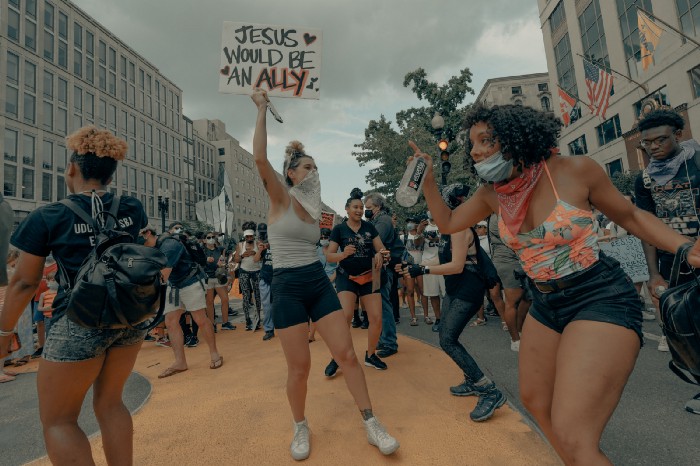
Amongst this backdrop of histories, stories and ruminations, “Zoom meetings” and “re-opening plans” fight to keep the comfortable positions they have held in my mind for the past few months. I can’t help but be shaken out of this quarantine lull into meditation as this week’s excitement about a Juneteenth grows. Imagine a Juneteenth on fire, a Juneteenth in public, a Juneteeth negotiating the same space politics of a group of newly freed blacks gathering at Liberty Hall in Philadelphia in 1809.
Nestled between, Memorial Day and the Fourth of July, we choose, in something like than five decades, to widely celebrate Juneteenth again. Still, I must humbly remind our Twitter-age Black consciousness, that this is not the first time we have made this decision. In America, nationally adopted holidays highlight painful cultural traumas and exclude us systematically from the nation’s historical narrative.
Famously, the ever eloquent, perfectly-coiffed Frederick Douglass lamented his invitation to speak at the National Celebration of the Fourth of July in 1852: “The sunlight that brought light and healing to you, has brought stripes and death to me. This Fourth of July is yours, not mine. You may rejoice, I must mourn. To drag a man in fetters into the grand illuminated temple of liberty and call upon him to join you in joyous anthems are inhuman mockery and sacrilegious irony. Do you mean, citizens, to mock me, by asking me to speak today?”[5] — A speech he gave on July Fifth, in protest.
This is the history of Emancipation celebrations from the very start. From Freedom Day to Emancipation Day to Juneteenth, Blacks have celebrated the legal freeing of the slaves in America on their own terms deliberately not allowing it to be appropriated or misconstrued, which is why the date had moved so much over the past two centuries. Emancipation scholar, Mitch Kachun reminds us that for American Blacks, celebrating out loud is more than having a good time. As I say, time and time again, for Black folks, joy is a radical act. He explains that holidaymaking is a particular ritual necessary for “self-definition and legitimization for a people in the process of becoming.”[6]
But, this, too, is originally American. For the American Project, nostalgia and mythmaking are tools consistently exercised to unify a young nation with a diverse mixing pot culture. In moments of social and cultural insecurity, we have chosen to celebrate.
This is true throughout our nation’s short history, and, throughout our Black American experience. In a previous set of writings on this same topic, I have looked at Kwanzaa as this example. A century after the wide adoption of Juneteenth, the founders of Kwanzaa revived the tradition of holiday-making but shifted the Black Holiday Tradition in a new direction.
Having rejected the goal of making America more inclusive, Black holidaymaking in the mid-1960s takes its cues from Frederick Douglass: holidays explicitly focused on critiquing the national festivals. But, it’s deep than that. We have to have a better appreciation of Black Radical consciousness because, more accurately, Kwanzaa was a part of a larger attempt to reorient the American definition as Afrocentric. Reviewing our national heritage through a black cultural lens challenges the established narrative in very uncomfortable ways, for Blacks and non-Blacks alike. But is it also, more accurate and immensely more fulfilling for us all.
But, the heart of the Black American festive tradition from Emancipation Day to Kwanzaa and beyond is in engaging those very questions of memory, witness, mercy, and joy. As we celebrate Juneteenth, both internally in our communities and externally with our allies in the face of an American audience on brimming with the potential of a transformative moment, let us remember this history. Our ancestors founded this tradition on three ideals: education, empowerment, and American accountability (not equity)[7].
Celebrating Black American holidays, specifically Juneteenth and Kwanzaa, is a tradition that reflects our collective power to create a shared black cultural identity on our terms.
We must always celebrate. Joy is a radical act.
So, if you protest with us, won’t you celebrate with us, too?
~C.
“National Jubilee of the Abolition of the Slave-Trade:
The undersigned committee of arrangement, appointed by the general meeting of the people of colour, for the celebration of the national jubilee, most respectfully inform the public, that they will assemble at Liberty Hall, on Monday morning, January 2, 1809, at 9 o’clock… Every exertion has been made… to show their gratitude in the most public manner, for so great a blessing…”[8]
~ The Wilberforce Philanthropic Association, January 1, 1809*
— —
further reads:
[1] At a numerous and respectable meeting of the Africans. 1807. The Providence Gazette 1807, sec XLIII.
[2] “Edmonia Lewis: Why Google celebrates her today.” (2017) AlJezeera.com. https://www.aljazeera.com/indepth/features/2017/02/edmonia-lewis-african-american-trailblazer-170201071933432.html
[3] Woodson, C. G., & Wesley, C. H. (1959). The story of the Negro retold. Washington: The Associate Publishers.
[4] Hill, J. (1996). Introduction: Ethnogenesis in the Americas, 1492–1992. In Hill J. (Ed.), History, Power, and Identity: Ethnogenesis in the Americas, 1492–1992 (pp. 1–19). Iowa City: University of Iowa Press.
[5] Douglass, F., & Foner, P. S. (1950). The life and writings of Frederick Douglass. New York: International Publishers.
[6] Kachun, Mitch. (2006). FESTIVALS OF FREEDOM: Memory And Meaning in African American Emancipation Celebrations, 1808–1915. Univ of Massachusetts Pr.
[7] Kultner, Paul, (2016) “The Problem with That Equity vs. Equality Graphic,” CULTURALORGANIZING.ORG http://culturalorganizing.org/the-problem-with-that-equity-vs-equality-graphic/
[8] Wesley, D. P. (1971). Early Negro writing, 1760–1837. Boston: Beacon Press.
* “N.B. The committee, after service, shortened their rout on account of the numerous spectators, and dismissed at the place of rendezvous, with the greatest acclamations of joy.” — from page 364
 Crishuana & Company