Tag: Crishuana.Com

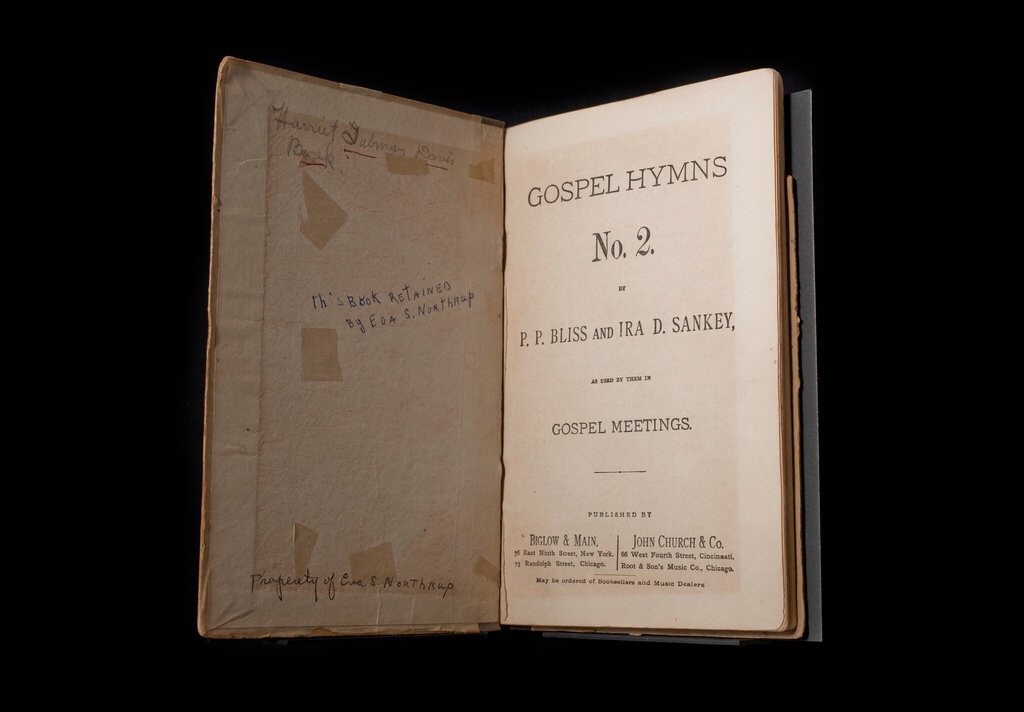
  • illiterate: the story of Harriet Tubman’s hymnal

    illiterate: the story of Harriet Tubman’s hymnal

    A version of this article by Lauren Christensen appears in print on December 24, 2017, on Page 23 of the [New York Times] Sunday Book Review

    illiterate: the story of Harriet Tubman’s hymnal

    [Photo Credit: Michael R Barnes/Smithsonian National Museum of African American History and Culture]

    In 2010, a church hymnal that once belonged to Harriet Tubman — the American abolitionist hero who, after escaping slavery in 1849, devoted her new freedom to leading hundreds more of her fellow enslaved out of captivity, first as a conductor on the underground railroad and then later as a Union spy — was donated to the National Museum of African American History and Culture by the collector and historian Charles L. Blockson.

    (more…)

  • Day 6. Kumbaa, #CELEBRATE, Ch. 3

    Day 6. Kumbaa, #CELEBRATE, Ch. 3

    25E6BA07-A474-45B0-A912-41807BED7602

    We don’t borrow
    from Africa,
    we utilize
    that which was ours
    2 start with.
    The culture
    provides a basis
    4 revolution
    + recovery. / -Maulana Karenga

    (7 Days of Kwanzaa. 7 Excerpts from Chapter 3 of a forthcoming essay series, #CELEBRATE: Meditations on a Black Festive Culture)


    Kwanzaa has a second giant to face: in the late 1970s period, the holidays had to resist against the increasing capitalism of America’s cultural institutions (i.e. museums, media, etc.). Specifically Kwanzaa had to take heed to the mainstreaming of multiculturalism. Still, we have to understand that Kwanzaa’s commercialization was complicated. Differing views on promotion and profit, exploitation and appropriation, and markets and multiculturalism caused much debate amongst Black Nationalists adopters as is true today.

    Some saw Kwanzaa as a vehicle for black participation in mainstream economic markets. They felt this was further continuation of the black cultural revolution. Others opinions wanted to invite white corporations to take part in the promotional campaigns for Kwanzaa. And then the most separatist opinions argued for a Kwanzaa was and should always be anti-commercialization. They argued that any type of commodification undermined the holiday’s reverence and sanctity.

    By the late twentieth century, the high visibility was almost entirely due to the appropriation of corporate, cultural and media institutions to gain black market share. But, in turn, the commercialization served to legitimize Kwanzaa in American public culture. Though the drive for the continued observance of Kwanzaa was shaped by Afrocentric perspectives in the 80s and the revival of Black Power styles in 90s, the political vocabulary from the 60s and 70s had became diluted into the cultural philosophy of multiculturalism.

    See, in the 1980s and 1990s, the importance of ethnicity and diversity provided previously unrealized access for people of color in a way that made them more politically, culturally and economically viable. But, it also made ethnicity a hot commodity for white owned corporations. While it’s true that entrepreneurs of color had more opportunity in this period, large white retailers primarily dominated the market for Kwanzaa promotion and black holiday observance.

    So what is Kwanzaa’s fate today? Basically, racial holiday markets provide companies a chance to increase profits while engaging in the peddling of diversity, inclusion and recognition. Black History Month has held this promise for some years now. But, museums and other cultural institutions aren’t exempt. Public discourse has folded Kwanzaa a standard part of an American year-end holiday trio. This does little more that present Kwanzaa as a token nod to diversity. And the celebration is often acknowledged simply out of goodwill or lip service for predominantly white serving institutions. Kwanzaa’s celebration in the public sphere was inherently tied to the marketplace and not a broadening of the American cultural landscape such as St. Patrick’s Day.
    Keith Mayes summarizes, “with the death of Jim Crow, Black political liberation opened up American society. Freedom, however, is a two-way street. If African-Americans gained access without, that means the dominant society also obtained liberty to move in.”

    Much like black lives, Black cultural celebrations only matter when they make American dollars.
    But, we know better.
    So we celebrate. 🎉

    keep celebrating. Ashé.
    (6/7)

    Read more on Kwanzaa’s 50th anniversary from its founder, Prof. Karenga here: http://www.ebony.com/wellness-empowerment/kwanzaa-50th-anniversary-karenga#axzz52vDztAJl

    thank you for going on this journey with me. Much gratitude to @HouseOfMamiWata in Houston, TX.
    Works cited to follow.

    Look out for the full mediation – #CELEBRATE: Meditations on a Black Festive Culture.

    As always,
    peace & blessings
    to you,
    family.

    Keep celebrating,
    -S.
  • Day 5. Nia, #CELEBRATE, Ch. 3

    Day 5. Nia, #CELEBRATE, Ch. 3

    EB07DF1D-2ED8-4F45-9355-4C5F5170DF95

    We don’t borrow
    from Africa,
    we utilize
    that which was ours
    2 start with.
    The culture
    provides a basis
    4 revolution
    + recovery. / -Maulana Karenga

    (7 Days of Kwanzaa. 7 Excerpts from Chapter 3 of a forthcoming essay series, #CELEBRATE: Meditations on a Black Festive Culture)

    With Kwanzaa, questions of ownership and representation by Blacks and Of Blacks are reconstructed as was the case for the original Emancipation Celebrations. As in previous black holidays, Black Americans hoped that one of the many commemorations on the calendar would make them culturally visible on the national level as had other white immigrant holidays had done. After repeated disappointments, they found the exclusion disappointing. There were certainly enough opportunities. On February 1st, 1948, the bill signing National Freedom Day as a nationally recognized holiday was put into law commemorating the Thirteenth Amendment against the backdrop of the MLB’s acceptance of Jackie Robinson.

    Carter G. Woodson’s Negro History Week become a month long observance at the national bicentennial celebration in the mid-1970s. The adoption of Negro History Month was challenged by blacks as too commercialized and no longer representative of the current desires for an African Heritage Month in August. The third publicly recognized black holiday came immediately upon Dr. King’s death. A resolution was introduced to nationally commemorate the assignation with House bill to designate his birthday on January 15th as a “legal public” holiday. Resultantly, celebrations caused conflict with those, who believed Malcolm X deserved an and innovative overdue for a similar celebration on May 19th. Dr. King’s holiday was mainly advocated for by politicians and by mainstream civil rights organizations and leaders.

    The hostile response of the US government caused the decline of Black Power nation-wide at the end of the 1970s, but Kwanzaa’s enormous publicity campaign in black urban neighborhoods represented the continued relevance of the cultural movement in at the local community level. Local Kwanzaa community organizing served as cultural educational sites, often by way of parades, community workshops and neighborhood forums. The grassroots structure re-positioned the black media as once again integral to sharing information. Both movement and non-movement sympathizers disseminated promotional coverage generated by black newspapers and magazines.

    Black TV personalities began morning shows with the Nguzo Saba seven principles. EssenceEbony and Jet magazines produced elaborate spreads about Kwanzaa. Pre-ceremonies even developed in some expressions for the earlier weeks of December before the first day of Kwanzaa. Often these ceremonies were held to help educate and de-mystify the holiday and these ceremonies provided an access point for blacks that did not interact with the local black nationalists organizations. From these points of nexus, the anti-Christmas rhetoric was soon dropped as it hindered prominent black religious leaders and their communities from participating and promoting the cultural exchange.

    All wax prints from post titles and Instagram are available for order from @HouseOfMamiWata African fabrics shop in Houston, TX.

    Many blessings, fam &
    Habari Gani until tomorrow,

    -C.