Tag: liberation

  • Day 5. Nia, #CELEBRATE, Ch. 3

    Day 5. Nia, #CELEBRATE, Ch. 3

    EB07DF1D-2ED8-4F45-9355-4C5F5170DF95

    We don’t borrow
    from Africa,
    we utilize
    that which was ours
    2 start with.
    The culture
    provides a basis
    4 revolution
    + recovery. / -Maulana Karenga

    (7 Days of Kwanzaa. 7 Excerpts from Chapter 3 of a forthcoming essay series, #CELEBRATE: Meditations on a Black Festive Culture)

    With Kwanzaa, questions of ownership and representation by Blacks and Of Blacks are reconstructed as was the case for the original Emancipation Celebrations. As in previous black holidays, Black Americans hoped that one of the many commemorations on the calendar would make them culturally visible on the national level as had other white immigrant holidays had done. After repeated disappointments, they found the exclusion disappointing. There were certainly enough opportunities. On February 1st, 1948, the bill signing National Freedom Day as a nationally recognized holiday was put into law commemorating the Thirteenth Amendment against the backdrop of the MLB’s acceptance of Jackie Robinson.

    Carter G. Woodson’s Negro History Week become a month long observance at the national bicentennial celebration in the mid-1970s. The adoption of Negro History Month was challenged by blacks as too commercialized and no longer representative of the current desires for an African Heritage Month in August. The third publicly recognized black holiday came immediately upon Dr. King’s death. A resolution was introduced to nationally commemorate the assignation with House bill to designate his birthday on January 15th as a “legal public” holiday. Resultantly, celebrations caused conflict with those, who believed Malcolm X deserved an and innovative overdue for a similar celebration on May 19th. Dr. King’s holiday was mainly advocated for by politicians and by mainstream civil rights organizations and leaders.

    The hostile response of the US government caused the decline of Black Power nation-wide at the end of the 1970s, but Kwanzaa’s enormous publicity campaign in black urban neighborhoods represented the continued relevance of the cultural movement in at the local community level. Local Kwanzaa community organizing served as cultural educational sites, often by way of parades, community workshops and neighborhood forums. The grassroots structure re-positioned the black media as once again integral to sharing information. Both movement and non-movement sympathizers disseminated promotional coverage generated by black newspapers and magazines.

    Black TV personalities began morning shows with the Nguzo Saba seven principles. EssenceEbony and Jet magazines produced elaborate spreads about Kwanzaa. Pre-ceremonies even developed in some expressions for the earlier weeks of December before the first day of Kwanzaa. Often these ceremonies were held to help educate and de-mystify the holiday and these ceremonies provided an access point for blacks that did not interact with the local black nationalists organizations. From these points of nexus, the anti-Christmas rhetoric was soon dropped as it hindered prominent black religious leaders and their communities from participating and promoting the cultural exchange.

    All wax prints from post titles and Instagram are available for order from @HouseOfMamiWata African fabrics shop in Houston, TX.

    Many blessings, fam &
    Habari Gani until tomorrow,

    -C.

  • Day 2. Kujichagulia, #CELEBRATE, Ch. 3

    Day 2. Kujichagulia, #CELEBRATE, Ch. 3

    92C93C5A-E73A-4E05-9611-448D0A5B69DE.png/ We don’t borrow
    from Africa,
    we utilize
    that which was ours
    2 start with.
    The culture
    provides a basis
    4 revolution
    + recovery. / -Maulana Karenga

    (7 Days of Kwanzaa. 7 Excerpts from Chapter 3 of a forthcoming essay series, #CELEBRATE: Meditations on a Black Festive Culture)

    Chapter 3. Reincarnation: “KWANZAA”
    Day 2: Kujichagulia

    Like black holidaymakers before it, this twentieth century holiday tradition struggled with questions of legitimacy.

    Explicitly targeting the calendar as a site of spatial negotiation, the creators of Kwanzaa and the Black Protest Calendar recast American holidays as white-centric extensions of Jim Crow exclusion. The New Black Power consciousness shifted from the patterns earlier black holidays established in the Antebellum and Progressive Eras. Black Power era holidays demanded recognition of the Afro-centric experience first and instead, created traditions around the ways mainstream white culture had failed it. The Black Protest Calendar sought to commemorate that fact that blacks were still not fully equal citizens instead of tacking their experience on to America’s mythology. They aimed to present celebrations that intentionally exposed how America’s freedoms and claims of morality were both false and ahistorical. You see, Kwanzaa was not rooted in a historical moment, but was a deliberate Black Nationalist response to their inability to identify with the cultural narrative of American festive calendar. Kwanzaa was created to be and still is, an active criticism of mainstream American celebrations.

    Beyond creating observances which challenged white holidays, the Black Protest Calendar based its memory  building on cultural events more relevant to the emerging consciousness. Progressive era and Antebellum black celebrations primarily included personality holidays such as Booker T Washington’s Birthday, Ida B Wells Day and a day for Frederick Douglass. Black Nationalists aimed to update these observances to include recent traumatic events, while continuing the tradition of celebrating race heroes. For example, the Black Protest Calendar includes observances for the assassinations of Dr. King and Malcolm X.

    The second aim of this expression of the Black Holiday Tradition was to place “anti-holidays” alongside mainstream holidays, challenging the inclusivity of American celebrations, including Thanksgiving, Election Day and, Columbus Day. But, most significantly for  understanding Kwanzaa was that the BPC reincarnated a Pan-Africanist consciousness into the existing black holidays. Freedom Day was abandoned as the original observance. Emancipation Day was resurrected as a celebration of black freedom which was now aligned with African independence struggles against colonialism on the Continent.

    Foundations of Kwanzaa can be said to have seeded in 1970 and 1971, when community organizer Edward Simms, Jr. created a Black Nationalist holiday called Umoja Karamu. Umoja Karamu was an attempt to renegotiate Thanksgiving. By holding it on the Sunday after Thanksgiving, the holiday became a way to reverse the “misgiving” of the holiday. It was also a holiday of feast and family, but it challenged European ideas of unity and proposed a more Afro-centric understanding. The celebration promoted harmony and was based on five major historical periods in the black American experience. During the feast, families presented historical readings, honored ancestors and shared foods that represented the five colors linked to the five historical periods. This pattern germinates in another Black Nationalist holiday established in this period: African Liberation Day. Founded by the great Kwame Nkrumah in 1958, it was adopted in America in 1963. By the 1970s, was considered to be one of the most widely celebrated black holidays on the calendar. Though it was African in its foundation, upon its adoption by newly Afro-centric Americans, it maintained the Protest Calendar tradition of American holiday critique. It is observed on the May 27th date, placing it right next to Memorial Day. This date placement was a direct challenge to American commercial and military involvement with oppressive colonial governments on the Continent.

    It is no wonder Kwanzaa is such a powerful expression of black American creativity because Maulana Kerenga, Kwanzaa’s creator and leader of the US organization in the late 1960s lived as a reinvention himself. During the Black Power era, “cultural recovery” was not simply at the holiday level, but it was also manifested in individuals who strived to embody the Afro-centric ideals of the era. Born Ronald McKinley Everett, he changed his name to a more “authentically African” name. Similarly his careful study of Swahili and Arabic showed that he, like, Paul Robeson before him, believed that African languages were a deep source of cultural pride and knowledge. Kerenga went on to earn multiple graduate level degrees in Swahili and African cultural studies. Author of Kwanzaa: Black Power and the Making of the African-American Holiday Tradition, Professor Keith A. Mayes refers to this process as cultural recovery, which he describes as, “The mere fact that “African-ness” had to be recaptured, re-donned, re-inculcated, and re-received meant that “Africa” at the level of geography, identity and consciousness had to be invented or re-invented by black Americans for black Americans.” For Mayes, Kerenga’s redefinition is inseparable from his political ideologies and invention of Kwanzaa.
    Performing Black Nationalism was inherent in his expression of self-identity.

    (2/7)

    All wax prints from post titles and Instagram are available for order from @HouseOfMamiWata African fabrics shop in Houston, TX.

    Sending you many blessings, family &

    Habari Gani until tomorrow,

    C.

  • Return of the Prodigal: a meditation

    Return of the Prodigal: a meditation

    A meditation on Luke 15:24.
    “For this my son was dead,  and is alive again; he was lost, and is found. And they began to be merry.”

    Sounds & voices:

    harmonies from my childhood ring out from the bathroom,
    French songs my father used to play from the radio.
    (I sing along with my broken French in my head)

    The image as he gets ready for work, I am swept away into nostalgia,
    a sweetness I had been craving
    my last six months in Nashville

    I am home.

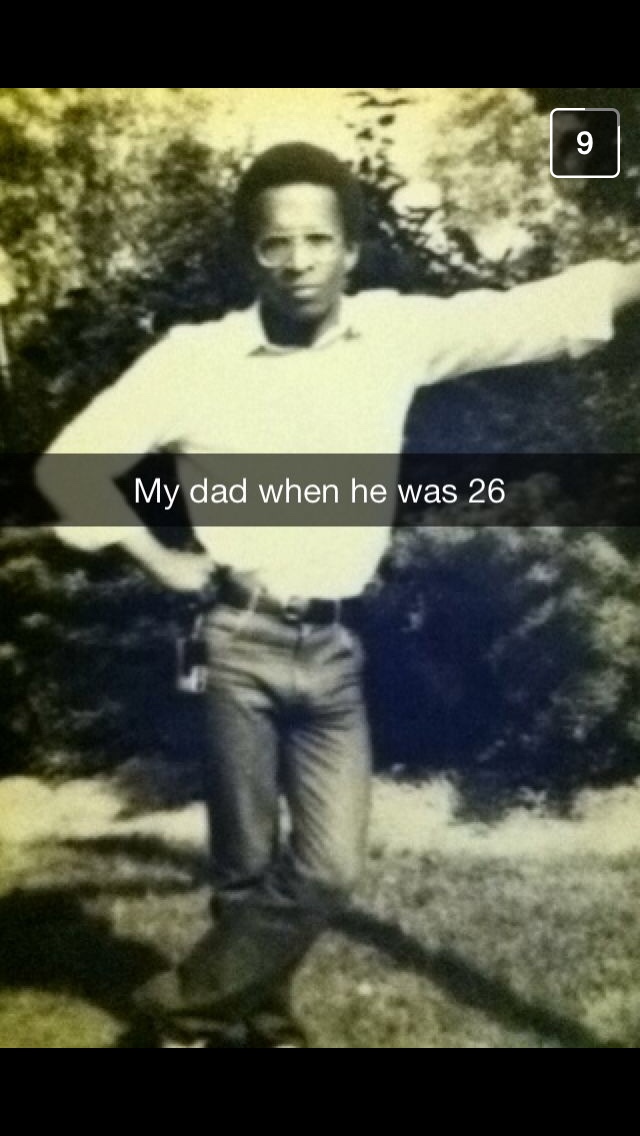
    I dream of my father as a young man,
    handsome and determined, very large glasses on a skinny frame
    making his way as a young African in newly independent Senegal

    or roaming the rues of Paris in search of a bon café,
    a noir in a sea of pale blanc.
    Perhaps a blonde girlfriend by his side
    as they bravely dare to redefine cultural taboos
    and overcome the racial socio-political walls between them.

    Just as soon, the Accura dealer is over the speaker
    reminding me that his new cars will bring me joy
    since my old Ford has a dented fender
    and expired plates.

    I am American again. The image is clear;
    my father, too, is American again,
    his citizenship codified some years ago
    by an oath and deep blue passport in hand.

    What was lost in gaining this new identity?
    I wonder as a few salty tears gently sliding down my cheeks surprise me
    and I am aware of the small lump
    in my throat.

    Happiness or sadness?

    Sometimes for me, they are the same.
    I am grateful to be home again,
    to find what I had been looking for.

    I am getting my life force back in to me slowly,
    everyday I am here, a little more.
    It was God’s grace that brought me home
    so that we all
    may be free to live again.

    Amen.